October 9, 2026

October Greetings,
We are visiting you this morning from the first crisp mornings of fall. The leaves are starting to change here in central North Carolina and the days are getting shorter. We’ve got lots of good stuff to share this month, let’s get to it!

Most of us have seen depictions of Obsessive Compulsive Disorder (OCD) on TV or heard someone casually describe themselves as “OCD” when they feel the urge to organize. The reality of living with OCD is much more isolating and impactful than the loudest stereotypes portray. In honor of OCD Awareness Month, I want to share what I have learned as a therapist who works with clients who live with OCD, how living with OCD has impacted my life, and ways to find support for yourself or those you love navigating this disorder.
OCD affects about 1 in 40 adults and 2.2 million children in the US, and is recognized by the World Health Organization as one of the top ten most debilitating illnesses in the world. OCD onset typically occurs in childhood to teen years or in early adulthood, but can happen at any time to people of all sexes, genders, races, ethnicities, cultures, and socioeconomic status, and is often brought on by stress, hormonal changes, and life transitions. On average, it takes over seven years for an individual to be accurately diagnosed with OCD; a long time to suffer with any ailment, let alone a disorder as intense and impactful as OCD. Research has also shown that women and girls face unique challenges, are more likely to have delayed diagnoses or be misdiagnosed, and are at a higher risk for negative outcomes associated with OCD, including suicide attempts, self-harm, and eating disorders. This statistic does not address the additional health disparities faced by people without white, and/or cis-het privilege.
- Harm (fear of hurting self or others)
Example: Layla is a nurse. She worries she will intentionally harm a patient by giving them lethal doses of medication. This fear causes her to become extremely anxious when dispensing and administering medication. To combat this, she engages in excessive checking of the medication and reassurance seeking by asking coworkers if they can ensure she is providing the medication as directed. Sometimes after her shift ends, she must check the patient’s chart from her home to ensure the patient has not suffered any adverse events.
- Contamination (fear of germs, illness, or feeling unclean)
Example: Carter has an intense fear of botulism. They remove the wrapper on canned items, run their fingers over the can, and look at the can under different lighting to ensure there are no dents that could cause contamination. Despite finding no damage to the can, Carter must boil the food for an additional 10 minutes after it is already cooked before eating it and check the temperature of the cooked food repeatedly to ensure it is safe.
- Perfectionism (excessive need for order, symmetry, or precision)
Example: LaShaun has an intrusive thought that his family will die if he does not carry out specific routines throughout the day. He spends an excessive amount of time showering in a rigid order, must take the same route to and from work, and must say the same prayer every night. This causes him to be late to work and miss family events and engage in mental review at the end of the day to ensure he has not missed anything.
- Taboo/Forbidden Thoughts (intrusive thoughts about sex, religion, or violence):
Example: Kayla is a Children’s Rights Advocate. She has intrusive thoughts about sexually abusing children that cause intense distress, like vomiting and panic attacks. To ensure she cannot harm children, she is considering quitting her job so she will not be around kids, and has stopped picking her niece up from daycare because she worries she will harm her. Kayla does “body scans” to see if she is feeling aroused and replays past events because she worries she has harmed a child and forgotten.
Additional subtypes include responsibility, real vs. false memory, emotional contamination, death and existence, identity, religious and moral, and relationship obsessions. Related disorders include other forms of neurodivergence, Anxiety, Body Dysmorphic Disorder (BDD), Eating Disorders, Body-Focused Repetitive Behaviors (BFRBs), and Hoarding Disorders.
Some obsessions and compulsions do not fit into any of these categories, but are usually helped by the same treatments used to address more common themes of OCD (Kelly, 2026). Contrary to popular belief and media representation, the majority of obsessions are not contamination-related, rather, most involve fears of harm, sexual or religious content, and morality-based themes. OCD typically causes multiple obsessions from a given subtype, predominant themes can shift over time, and people often experience obsessions and compulsions from multiple subtypes of OCD. Take it from someone who experiences multiple subtypes of OCD: just as you feel you have a grasp on one obsession and compulsion, another one pops up like the worst version of nightmarish Wack-A-Mole.
In OCD, obsessions and compulsions are ego-dystonic, meaning they are unwanted and distressing to the sufferer, and are out of alignment with their values and beliefs. In fact, OCD leeches onto what you value most. OCD is frequently referred to as “The Doubting Disorder”, which stands to reason that someone would not worry about doubting something that did not matter to them. In other words, someone who wanted to cause someone harm would likely not be this distressed about possibly causing it.
OCD repeatedly forces survivors on a non-consensual mental rollercoaster of unwanted images, thoughts, and fears, and convinces us that without the control of compulsions, we will cause the horrific demise of the people, things, or concepts we value most. Stigma, misdiagnosis, and lack of awareness can leave survivors silenced with the feeling that even having these thoughts is too shameful to bear. Let’s be honest: in most circles, disclosing that you have anxiety about a performance review lands differently than confessing that you have graphic, unwanted images of harming your beloved pet. Of course, we have natural human reactions to distressing thoughts. We can also acknowledge that the presence of a thought does not equate to the desire or intention for it to come to fruition.
Our brains are beastly thought machines, producing 48.6 thoughts per minute, totaling about 70,000 thoughts per day. As you can imagine, dear reader, not all of those thoughts need to become actions (late night million dollar ideas that seem less lucrative in the morning, anyone?). Thoughts are just that — thoughts. The level of risk that brains with OCD perceive in response to distressing thoughts causes thoughts to become sticky and enter a loop, demanding our attention. In an effort to quell the associated discomfort, people with OCD say, do, and/or think specific things that their mind tells them will shut off the blaring fire alarm in their heads. Unfortunately, these behaviors establish a pattern that tells their brains the fire alarm can only be shut off by completing a compulsion, and this leads people to rinse and repeat, creating a vicious cycle of thoughts and compulsions. Because our brains often fail to successfully differentiate excited and fear-based arousal, some people living with OCD experience groinal responses, which involve tingling, warmth, a tickling sensation, or an erection during nervous system activation during the presence of obsessions. These can be perceived as evidence of arousal in those with sexual harm-themed obsessions when they are actually experiencing a fear-based response.
Between the deluge of thoughts, time-consuming compulsions, related distress, and frequent isolation, OCD can seem inescapable. However, there is hope. The gold-standard treatment for OCD is a type of Cognitive Behavioral Therapy (CBT) called Exposure and Response Prevention (ERP). ERP utilizes gradual, safe exposure in controlled environments, exposing the patient to feared stimuli and interrupting the compulsive behaviors, thereby interrupting the OCD cycle as a whole. An integral component of ERP is the removal of reassurance. Around 50–60% of people who complete ERP treatment show clinically significant improvement in OCD symptoms that have been found to be maintained long-term. For those which ERP is not clinically recommended, effective, or accessible, second and third line treatments for OCD include Selective Serotonin Reuptake Inhibitors (SSRIs) and some forms of talk therapy, including Inference Cognitive Behavioral Therapy (I-CBT), and Acceptance and Commitment Therapy (ACT).
Supporting someone you love with OCD could first look like expressing concern for what they are experiencing, sharing resources or information with their consent, and eventually, offering to engage in their treatment with them to learn how to support them without contributing to the cycle. For people who think they might be suffering from OCD, those living with it, or people with a loved one with OCD, resources are listed below.
As a mental health professional, I did not know most of this information until I was out of grad school and suffering from intensified OCD symptoms myself. This highlights the lack of information known and shared about OCD, even in clinical spaces. OCD is not a joking matter, and it is surely not an adjective. What I am still learning myself, and hope to impart to you, is the hope that comes with the knowledge that we can find relief. Support is available from therapists who hear from other people experiencing intrusive thoughts (probably surprisingly similar to yours) every day. You are not alone, and for what it’s worth, you can actually become quite skilled at OCD Wack-a-mole.
OCD Resources
Take Root Intern: Amy Richards, specializes in working with folks with OCD and offers ERP and other modalities. Amy will be joining the practice as a full-time clinician upon graduation in January, and folks are encouraged to reach out to join her waitlist if interested in working with her: amy@takerootpllc.com
Find a therapist specializing in OCD: PsychologyToday.com
Learn more about OCD: https://iocdf.org/
https://psychiatry.duke.edu/duke-center-girls-women-adhd
https://www.nami.org/types-of-conditions/obsessive-compulsive-disorder/
References
American Psychiatric Association. (2022). Obsessive-compulsive and related disorders. In Diagnostic and statistical manual of mental disorders (5th ed., text rev.). doi.org
American Journal of Medicine. (2025, June). A selection of fascinating facts about the brain and heart. https://www.amjmed.com/article/S0002-9343(24)00772-1/fulltext
Does Pure O Exist?. OCD-UK. (n.d.). https://www.ocduk.org/ocd/pure-o/
Duke Department of Psychiatry & Behavioral Sciences. (n.d.). Duke Center for Girls & Women with ADHD. Duke Center for Girls & Women with ADHD. https://psychiatry.duke.edu/duke-center-girls-women-adhd
International OCD Foundation. (2026, June 3). What is OCD? https://iocdf.org/about-ocd/
Kelly, K. (2026, September 14). OCD subtypes: 7 common types of OCD explained. https://www.scienceworkshealth.com/post/ocd-subtypes-explained-a-guide-to-the-different-forms-of-ocd
Law, C., & Boisseau, C. L. (2019). Exposure and Response Prevention in the Treatment of Obsessive-Compulsive Disorder: Current Perspectives. Psychology research and behavior management, 12, 1167–1174. https://doi.org/10.2147/PRBM.S211117
The National Council of Integrative Psychotherapists. (2024, February 9). Understanding groinal responses in OCD: Insights for professionals and individuals. https://www.the-ncip.org/articles/understanding-groinal-responses-in-ocd-insights-for-professionals-and-individuals
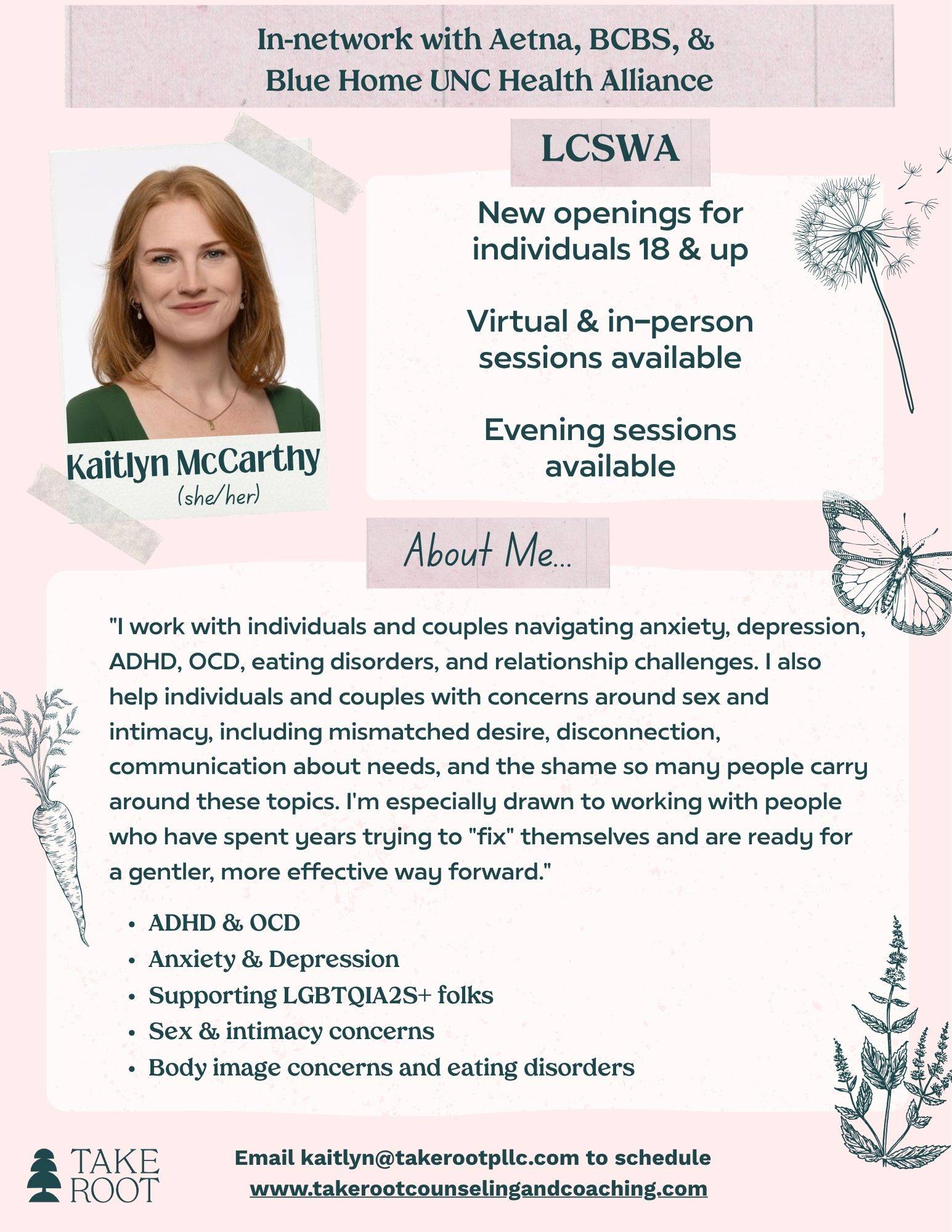
We are so excited to welcome Kaitlyn to the Take Root team! Kaitlyn sees adults and couples in our Cary office and can see clients virtually in NC. Kaitlyn loves working with people who need help navigating ADHD, OCD, and relationship challenges. She is specializing in eating disorders and body image challenges. Kaitlyn works from a deeply person-centered foundation and utilizes a variety of approaches including DBT, CBT, Mindfulness and highly individualized solution focused therapy.
We are thrilled to have her warmth, expertise and presence on our amazing team!
Schedule a consult with Kaitlyn
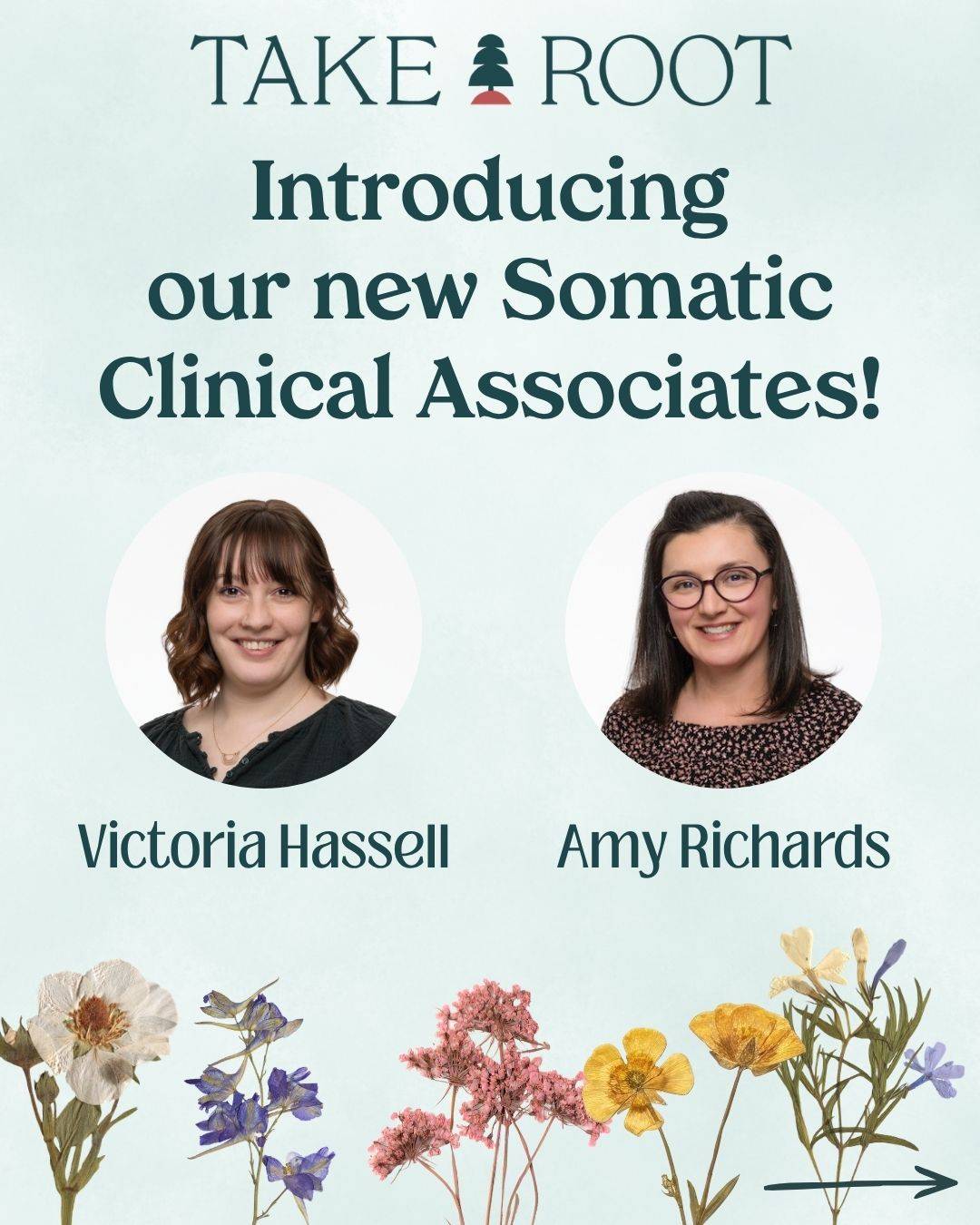
We are so thrilled that two of our phenomenal team members have decided to step into our Somatic Clinical Associate Program. This is a year-long intensive that includes intricate clinical training in the utilization of somatic approaches to provide treatment for those struggling with eating disorders and other challenges related to trauma and attachment disruption. These two are already skilled and attuned clinicians who will add even more depth and presence to their work through this experience.
Victoria currently has availability for new clients. She specializes in neurodivergence and attachment. Schedule with Victoria: victoria@takerootpllc.com
Amy is finishing her internship, graduating in December, and is adding clients to her 2027 waitlist. Request to be added to Amy’s waitlist: amy@takerootpllc.com
Our Community Partners

Woven Roots: Circle for Ecological Belonging
A monthly community gathering rooted in Forest Therapy, EcoSomatics, the Work That Reconnects, Ceremony & Ritual, Wheel of the Year, Ecological Hope and environmental kinship.
- Now meeting on Sundays! 9:30a-11:30a
- Enjoy invitations to slow down and land with the river Haw and surrounding forest.
- Commune with the more-than-human-world through our sensing body.
- Guided embodied ecology practices.
- Intentional community connection.
- Gratitude, honoring, threshold crossing & integration rituals.
- Tea ceremony with the forest.
- Leaving with a deeper sense of belonging.
- Open for all adults 18+
- Co-facilitated by Sara Riggs LCSW, EcoSomatic Therapist & McKenzie Bossert LCMHC, Certified Forest Therapy Guide
Upcoming Support Groups
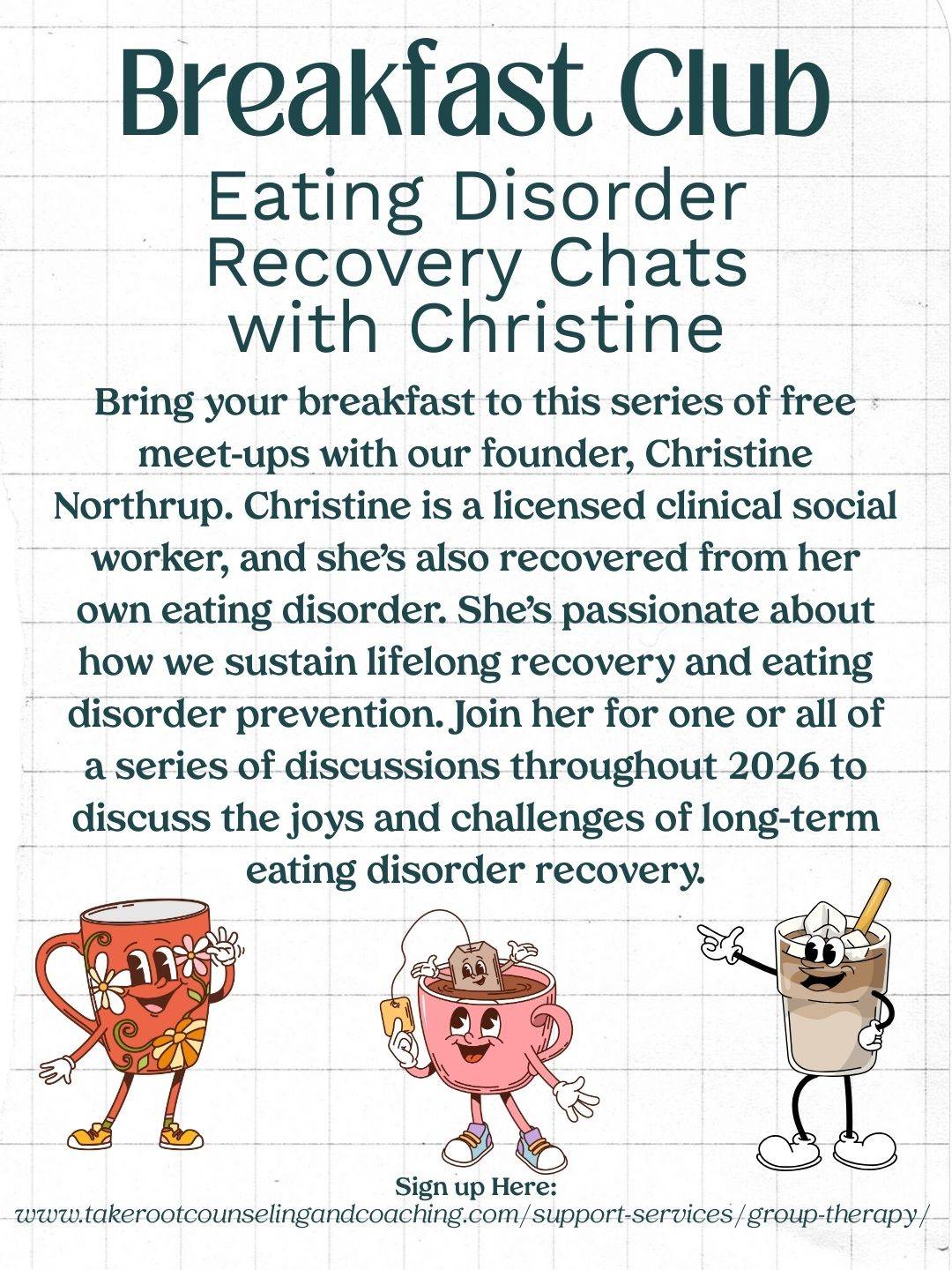
Dates: Meeting monthly on: 10/15, 11/19, & 12/17
Time: Mornings, 8:30 – 10:00 am
Location: Our lovely office, 102 New Edition Court, Cary, NC
Cost: FREE
Who: This group is for folks 18+
Some things to know…
- All sessions are free of charge, but please make sure to register so we know to expect you
- This is not a meal support group, but it is a space designed to include eating so please bring your breakfast or your morning snack (for you early risers) and plan to meet your needs during the discussion.
- All those engaged in eating disorder recovery are invited to this discussion whether new to the process or long recovered. Whether the ask to eat during the chat is easy peasy or very scary, you get to be a part of the discussion.
If you made it this far, thanks for reading! We look forward to visiting your inbox again soon:) If the info in this email felt helpful, and you know someone who might also think so, please consider passing it along and sharing- we are so grateful for your support.
Kindly,
The Take Root Team
Receive this email from a friend or loved one? If you’d like to read The Sprout monthly, please consider signing up HERE.