May 5, 2026

May Greetings,
It’s hard to believe we are one third of the way into 2026. We recently got some much needed rain and are basking in beauty of new things blooming daily here in North Carolina. Take Root is celebrating a birthday milestone and we’ve got lots of other great stuff to share with you this month.

There is a common assumption in mental health, and in our culture more broadly, that if we can understand ourselves well enough, think differently enough, or become disciplined enough, we will naturally begin living differently. And yet, in both my own life and clinical work, this assumption often falls short. Even with abundant intelligence, insight, and genuine self-awareness, some patterns in our lives can feel remarkably resilient and fixed in place despite our best efforts to understand them. We may analyze them, trace their origins, and even criticize ourselves for repeating them, yet still find ourselves returning to the same reactions. This can be especially frustrating for natural problem-solvers, for those who have long relied on intellect, reflection, and understanding to navigate difficulty. It makes sense that when a life spent solving problems through insight encounters a kind of problem that insight alone cannot resolve, one begins to feel at a loss. Insight matters, but insight alone is often not enough to create lasting change. Many of the patterns that keep us stuck are sustained not by a lack of intelligence or self-awareness, but by how we relate to our thoughts, emotions, and internal narratives. Lasting change often requires psychological flexibility, the capacity to hold our inner experience differently, so that we can respond with greater freedom, intention, and alignment with what matters most.
I think that this is where Acceptance and Commitment Therapy (ACT) can be especially helpful. At its core, ACT is concerned with psychological flexibility, which is the capacity to encounter difficult thoughts, emotions, and internal experiences without becoming governed by them, and to continue moving toward what matters even when discomfort is present. Much of ACT rests on the premise that the more we struggle to eliminate uncomfortable thoughts and feelings, the more entangled we become with them. Anxiety about making a mistake leads to hypervigilance; hypervigilance amplifies the sense that a mistake would be catastrophic; perfectionism tightens its grip. What began as a strategy to protect ourselves from discomfort becomes the very mechanism that sustains it.
ACT does have its limitations; it does not promise to erase pain, eliminate injustice, or help us “think our way out of systemic realities that must be addressed beyond the therapy room. We cannot “therapy” our way out of structural oppression. We cannot “positive-think” our way out of genuine loss. Some conditions must be changed externally. And yet, there are patterns that persist even when circumstances shift (patterns of avoidance, self-criticism, rigidity, or fear) that keep us from moving toward what matters, patterns of avoidance, self-criticism, rigidity, perfectionism, or fear that quietly shape how we move through the world. These are often not imposed from outside of us so much as reinforced by how we respond internally. We begin organizing our lives around avoiding discomfort. We postpone difficult conversations, withdraw from opportunities, avoid uncertainty, hold ourselves to impossible standards, or wait until we “feel ready” before taking meaningful action. In trying to protect ourselves, we often become smaller.
In response, ACT cultivates a different posture: acceptance, allowing discomfort, fear, doubt, and frustration to exist without immediate attempts to suppress or escape them; learning to recognize thoughts as mental events rather than truths carved in stone, so that “I can’t do this” becomes understood as a sentence the mind is producing, not a verdict on identity; and contact with the present moment, shifting attention away from rehearsed future failure or recycled past embarrassment and back toward what is actually here, concrete and immediate. When anxiety says, “Don’t risk it,” flexibility allows us to hear the warning without obeying it automatically. When perfectionism insists, “Not good enough,” flexibility allows us to keep moving anyway. When identity hardens around statements like, “I’m just this kind of person,” flexibility introduces the possibility that we are larger than the stories we tell ourselves.
This is what ACT calls cognitive defusion, learning to relate to thoughts as mental events rather than fixed truths. One simple way of accessing this skill is to add a small phrase in front of difficult thoughts: instead of “I’m failing,” one practices saying, “I’m having the thought that I’m failing.” That small shift can create just enough distance to see the thought differently. I like to picture this as allowing our mind’s eyes to observe our own thoughts. Another practice is to gently name familiar patterns of mind—the inner critic, the worrier, the perfectionist, the catastrophizer. Naming these voices is not meant to dismiss them, but to help us recognize them as recurring processes rather than objective reality.
ACT works to cultivate what is called “self-as-context,” which is a loosening of the equation between performance and identity (literally it means the developing of “yourself as a concept you can observe,” rather than just the self you experience). We are not reducible to our thoughts, not defined entirely by our mistakes, and not exhausted by the stories we tell about ourselves. There is something in us capable of observing experience without being wholly consumed by it. Self-as-context is the ability to notice the mind at work, to become aware of naming, judging, comparing, predicting, catastrophizing, and constructing narratives about who we are. The mind is constantly generating commentary. Some of it is useful. Much of it is repetitive, reflexive, and shaped by old learning. A difficult moment becomes, “I always do this.” A setback becomes, “I’m not capable.” Uncertainty becomes, “Something is wrong.” Shame becomes, “This is who I am.”
Mindfulness in ACT serves a similar purpose. This is not mindfulness as escape, nor mindfulness as a demand to become perfectly calm. It is a practice of contact with what is here—returning attention to breath, body, sensation, and immediate experience without rushing to interpret or fix it. If anxiety arises, one might notice tightness in the chest, warmth in the face, a racing mind, and simply observe: this is anxiety being felt in the body. Not I am broken, not I need this to stop, but this is what anxiety feels like right now. That shift matters. It turns reaction into observation.
Over time, this cultivates a different relationship to discomfort—what ACT often describes as willingness or acceptance. Acceptance here does not mean approval, resignation, or passivity. It means making room for experience without organizing one’s entire life around avoiding it. It is the willingness to feel awkwardness while learning, uncertainty while choosing, sadness while grieving, fear while risking, or vulnerability while loving. It is a quiet recognition that discomfort is often part of living meaningfully, not always evidence that something has gone wrong.
And this is where ACT turns toward what may be its most important question: What matters? Not what guarantees comfort. Not what avoids criticism. Not what makes us look successful. But what genuinely matters—how we want to live, how we want to love, how we want to show up in our work, relationships, and communities. Courage. Integrity. Compassion. Honesty. Presence. Creativity. Service. Care. These are values—not destinations to arrive at, but directions in which to travel.
And finally, ACT asks that values be translated into lived behavior through committed action—the decision to continue, to speak honestly, to risk, to attempt, and to move toward what matters even while fear remains in the room. Often, these actions are small and ordinary: making the difficult phone call, attending the event you would normally avoid, setting a boundary, beginning the project imperfectly, apologizing sincerely, applying for the opportunity despite self-doubt, or simply staying present in a hard conversation rather than retreating inward. These are not abstract therapeutic ideas so much as disciplines of living—skills that require practice, self-awareness, and repeated return. Over time, such ordinary acts become the architecture of change, loosening the grip of old patterns and making room for new ways of responding.
If there one thing that I always find humbling about ACT it is that there is always room still to grow with these skills. We do not outgrow self-doubt permanently, we do not eliminate fear, we do not silence the mind’s commentary, we cannot shut off an active mind from to overthinking. The work is ongoing. The practice is to notice, return, and choose again. To become more aware of the narratives that shape us. To hold them more lightly. To act with greater deliberation. And in the end that the kind of daily stretch that ACT demands. It is daily practice of mental stretches for psychological flexibility.
References:
Hayes, S. C., & Lillis, J. (2012). Acceptance and commitment therapy (Theories of Psychotherapy Series). American Psychological Association.
Hayes, S. C., Strosahl, K. D., & Wilson, K. G. (2012). Acceptance and commitment therapy: The process and practice of mindful change (2nd ed.). Guilford Press.

Our Community Partners
Lutz and Alexander has a new 4-week parent education group, an “Eating Disorder Treatment 101″-style series, to help parents better understand eating disorder care and how to support their child.
Group Details:
Understanding Eating Disorder Care: An Introduction for Parents & Caregivers
Facilitated by Annie Penrose, M.Ed., RD, LDN
May 13, 20, 27, and June 1
5:30–7:00 PM
In person at our Raleigh office
$250 (includes up to 2 caregivers for the full series)
For more information or to register:
https://lutzandalexander.com/groups/parent-group/
Upcoming Support Groups
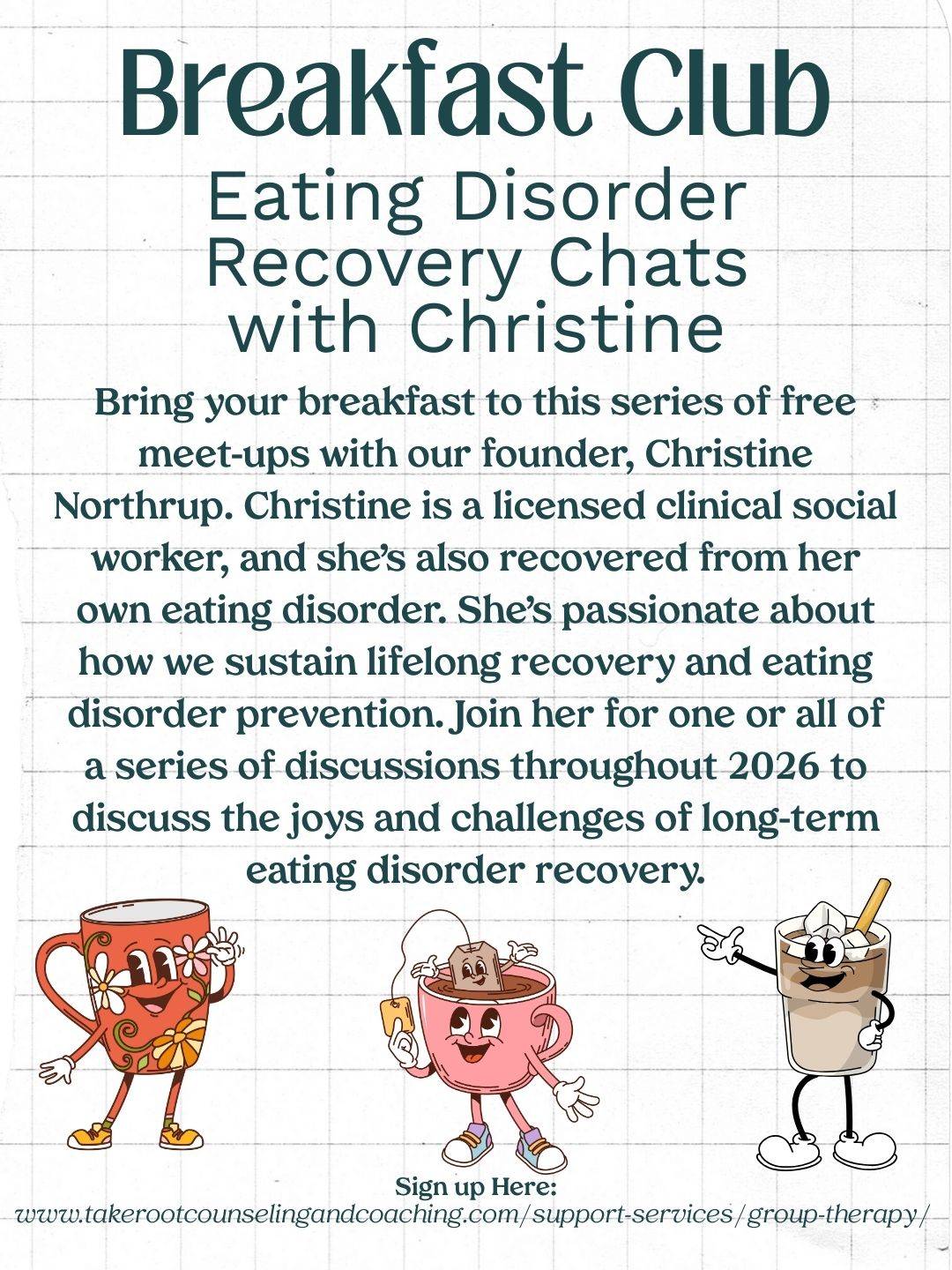
Dates: Meeting monthly on: 5/14, 6/18, 7/16, 8/13, 9/17, and 10/15
Time: Mornings, 8:30 – 10:00 am
Location: Our lovely office, 102 New Edition Court, Cary, NC
Cost: FREE
Who: This group is for folks 18+
Some things to know…
- All sessions are free of charge, but please make sure to register so we know to expect you
- This is not a meal support group, but it is a space designed to include eating so please bring your breakfast or your morning snack (for you early risers) and plan to meet your needs during the discussion.
- All those engaged in eating disorder recovery are invited to this discussion whether new to the process or long recovered. Whether the ask to eat during the chat is easy peasy or very scary, you get to be a part of the discussion.

Dates: July 9th, 16th, 23rd, & 30th (4 weeks)
Time: Thursdays, 6:00 – 7:00 pm
Location: In-person at our lovely Take Root Office, 102 New Edition Court, Cary, NC 27511
Cost: FREE
Who: This group is for folks 18+
This free, 4-week in-person support group is designed for LGBTQ+ identifying individuals 18+ who are navigating recovery from eating disorders. Led by Jordan “JP” Poole—a queer-identifying therapist with extensive experience treating eating disorders — and social work intern Amy Richards, this group offers a safe, affirming space to share, connect, and heal.
Together, we’ll explore the unique challenges at the intersection of identity and recovery, process personal experiences, and build practical skills to support long-term well-being. Each week will provide opportunities for both open discussion and guided learning, grounded in compassion, community, and evidence-based approaches.
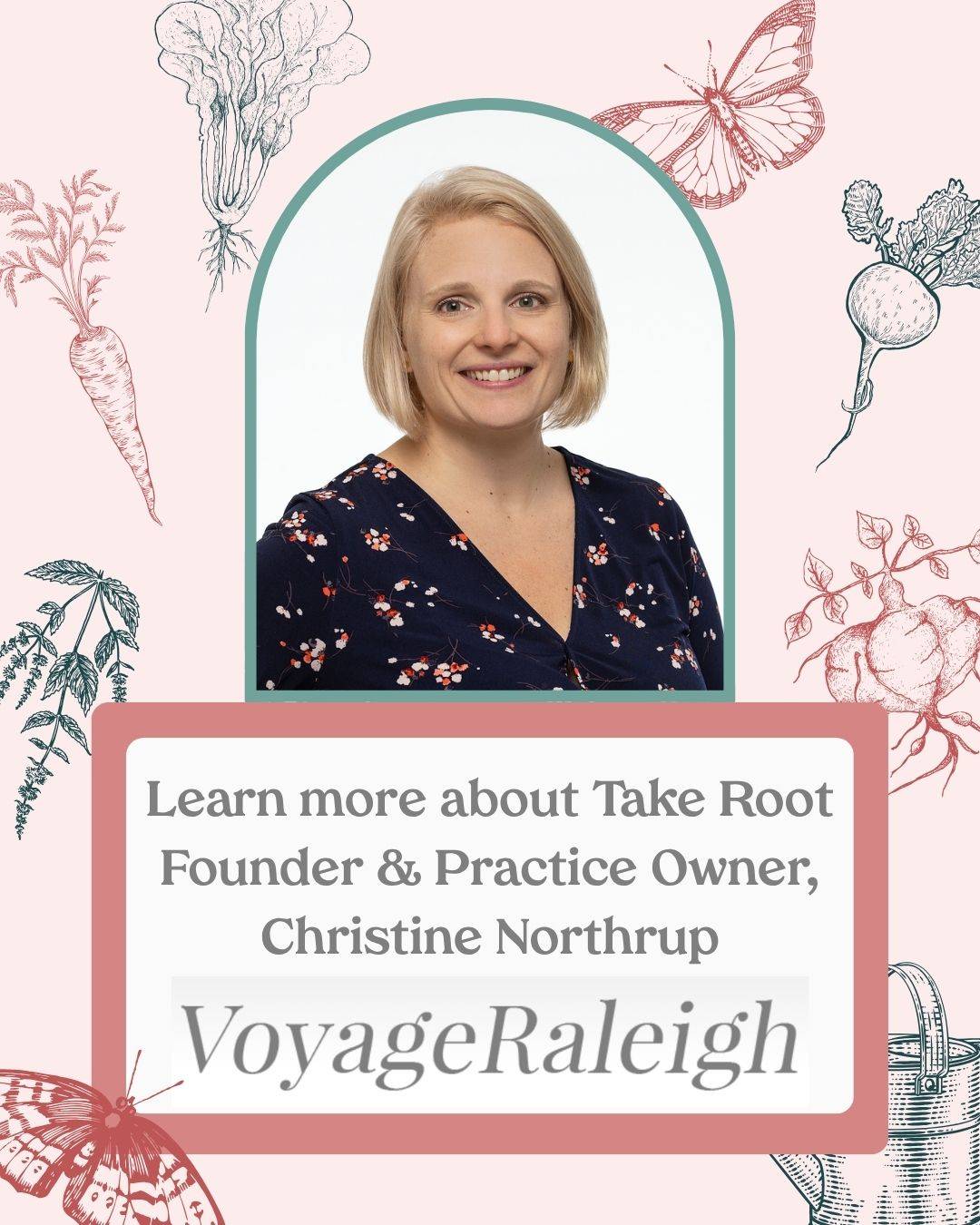
Christine had the opportunity to share more about her personal journey that paved her way to a career as a therapist and meal coach for folks with eating disorders and body image concerns as part of Voyage Raleigh’s inspiring stories series. Read the full article HERE.

Take Root is in the midst of its 5th anniversary and in reflecting on 5 years, the word relationship is one I really want to highlight because it is truly why Take Root exists and has become the special place that it is.
It has been a big year in this wild and strange business of therapy. I say wild and strange because, truthfully, the job is quite unique. We have highly trained clinicians with years of training and advanced clinical skill. That is a lot of what we’re spending our time doing with clients but we are also sharing our relational capacity, lending our nervous systems and developing very intentional professional relationships which become a foundation for healing, learning and regulation occur. The therapeutic relationships we have with many, many people are powerful. They are life-changing relationships and it is our actual job to participate in them, with boundaries, yes, but also with authenticity, care, and attunement. To be chosen by people committed to doing the work of showing up for therapy is a role that we, at take root, have the upmost reverence for.
In our growth this year, we’ve been able to also grow the amount of people that we serve. We stretched our way into South Carolina, added clinicians and built foundation for more intentional growth. We deepened relationships with each other as a team and sprouted new ones as we collaborated on cases, built new services and programs and made community building a team effort. Being on the Take Root team is a practice of collaboration and ongoing pursuit of both learning from one another, growing based on what we learn, and willingly participating in helping one another be the very best clinicians that we can be. It’s a joy to build and grow this team and it is my honor to also be a part of this esteemed group. That they would choose to come build this with me continues to humble and delight me and I believe I am a better therapist and leader for those relationships.
Lastly, I want to highlight the relationships that we have with our community. As eating disorder providers we work on teams and so we have a lot of ongoing collaborative relationships with other providers all over NC and SC, some even further away. These are so important to us and to the clients we serve. We are deeply grateful and feel so lucky to get to work in a such a dedicated community of providers who have also joined us in the role of building relationship in the service of helping people heal themselves and transform in ways they may never have even been able to imagine. Thank you for trusting us and thank you for being people we can trust.
Here’s to growth and to all that it takes and to the relationships and support it in happening.
If you made it this far, thanks for reading! We look forward to visiting your inbox again soon:) If the info in this email felt helpful, and you know someone who might also think so, please consider passing it along and sharing- we are so grateful for your support.
Kindly,
The Take Root Team

Receive this email from a friend or loved one? If you’d like to read The Sprout monthly, please consider signing up HERE.