November 16, 2026

November Greetings,
Whether and however you might be gathering this month, we hope you can slow down to enjoy the small moments with the ones you love. If family stuff feels tougher around the holidays, keep reading for helpful tips on how to support yourself and family when complicated dynamics present themselves. We are grateful for you this November and all year through.
Home for The Holidays: A Guide to Surviving
Holidays can be an exciting time of year, but for many of us, they bring anxiety, grief, and anger to the forefront. According to a study conducted by the National Alliance on Mental Illness (NAMI), 64% of individuals living with mental health disorders report their symptoms worsen around the holidays. Given the emphasis on social connection around the holidays, unique complications arise: What if I don’t feel comfortable bringing the person I love to family dinner? What if they bring up my weight? Will an abuser be there? What will they say to me?
A poll completed by the American Psychiatric Association (APA) found that nearly one in three adults worry about dealing with challenging family dynamics around the holidays. Contrary to the all too familiar trope of “But they’re your family”, I believe choosing what is best for you is best for you. The holidays should not require a shiny, easily digestible, or agreeable version of you. You deserve a holiday that meets you where you are and honors your values, needs, and boundaries.
Whether you choose to engage with complicated relationships with added boundaries, are exhausted from the year and only have the capacity to go with the flow, or choose to abstain from family events altogether, there can be a variety of decisions that support you in your needs. After all, aren’t holidays supposed to be a time of celebration, warmth, and generosity? No matter how you choose to celebrate (or not), here’s a non-exhaustive list of practical ways to support yourself through the season.
If you’re choosing to engage:
Boundaries: Make a list of your non-negotiables. What is okay and not okay for you? Boundaries are not always just about communicating what you are comfortable with, but also setting a standard for how you will respond. Set boundaries before holiday interactions to ensure your needs and expectations are known.
“I have felt really uncomfortable in the past when X. Going forward…”
“Do not talk about my body. If you do, I will leave.”
“I’m not open to comments about my sexuality. If you continue bringing this up, I will hang up the phone.”
“I don’t want a hug today, but I’m glad to see you.”
For people with eating disorders and disordered eating patterns, the holidays can feel especially full of landmines. For example, eating in front of others, seeing people for the first time after shape/size/appearance changes, expectations about eating certain amounts, exposure to a variety of foods and food groups, and consuming food prepared by others can contribute to significant distress. Given the severe implications and relapse rate of eating disorders, the holidays are a time to consider increasing your support as a person in recovery, and a time to boldly support your loved ones as an ally.
If specific people are repeat boundary-crossers, consider not inviting them or having a conversation detailing clear boundaries, ahead of being all together. People who need additional accommodations or support are not a problem to be solved, and should not be forced to navigate these situations alone or at the expense of their well-being. While it is often easier in the moment, doing nothing can cause significant harm to the survivor.
For caregivers/bystanders supporting loved ones:
Increase your own support around the holidays, whether that is calling a friend, taking time for yourself, or engaging with a mental health professional. The Trevor Project found that LGBTQ+ youth who had at least one supportive adult were 40% less likely to report a suicide attempt in the past year. Do not underestimate the value of being that person.
For queer folks, sometimes no amount of boundary setting will allow someone to have a safe holiday. In those situations, consider bolstering support through friends and chosen family, and joining groups or clubs in your community.
If something comes up in the moment, speak up if you are safely able to do so. Some examples:
“Don’t talk to them like that.”
“Let’s change the subject.”
“It’s not okay to comment on people’s bodies.”
“That’s not funny.”
“Lane goes by he/him now. That is an expectation we have for everyone around him. If that’s not something you’re comfortable with, we will pass on Thanksgiving dinner this year.”
“I know you don’t understand my perspective, but in my house, we don’t say those things. If you can not respect that, I will ask you to leave or go to another room.”
“You’ve continually crossed my/our/their boundaries. It’s time for you to go home now.”
Buddy System: Consider inviting a friend/support to join you, or have someone on standby. This can look like letting them know the day may be difficult for you and why, simply asking them to check in with you at certain times, or planning a leftover party/debrief gathering. Be as honest with them as you are able. Let them know your fears, if there is anything they can do to support you, and brainstorm practical approaches.
“If I squeeze your hand three times, I need to go for a walk.”
“If I grab my coat, I am ready to leave.”
“I’m purposefully leaving my water bottle in the car. Can you come with me when I go to get it so we can reset together?”
“I’ve noticed my leg shakes when I’m at my max. If you see that happening, can you let me know so we can tap out?”
Listen to Your Body: If you need a break, take one. Consider taking a coping kit or a few pocket-sized items to help ground you (a sour candy or mint, essential oils, and/or a fidget). Go to the bathroom and reset or get some fresh air.
Auto-Replies: If there are certain comments or topics that are repeatedly discussed without your consent, have some phrases in your back pocket to access as needed, and remember, “No” is a complete sentence.
“Let’s talk about something else.”
“That’s not something I am discussing today.”
“That is an interesting thing to say out loud.”
“I’m not comfortable with this conversation.”
“I appreciate your concern, but now is not the time to discuss this.”
“That’s not up for debate with me.”
“No.”
Have an Exit Plan: In the event your boundaries have been crossed or you no longer want to be there, you can give yourself permission to leave. Your presence is a gift, not a requirement, no matter what Aunt Susan says. Make plans ahead of time. Are you only able to survive an hour of yuletide togetherness? Set expectations before you arrive so you do not have to do this in the heat of the moment.
“Alix and I will be stopping by, but we will be leaving by 2. Looking forward to seeing you!”
If needed, spontaneously remember you forgot to feed/water something, or have a friend call you with an emergency (see buddy system).
After-Care: Have something enjoyable or restorative waiting for you: whether that’s a new vacuum (I’ve reached that point of adulthood), a pie, a hot bath, a bed, or something else — I will leave that up to you to decide — but intentionally do something kind for yourself. Listen to your needs. Need to debrief? Do that. Need to sit in silence and watch a comfort show? Throw it on. Let yourself settle back in.
If you’re choosing not to engage:
New Traditions: Have you always hated your mom’s casserole? Congrats! You don’t have to think about it for another second. Take this opportunity to do things you have always wanted to do. Go new places; create new memories.
Groups: Find support and/or social groups in your area to boost connection, validation, and have a specific reason to leave the house when staying in can be really tempting (and also a valid option).
Un-Holiday the Day: When navigating grief and trauma, holiday cheer can feel deeply upsetting. Choose options in apps to see less holiday content, or hop off socials altogether for the day, the week, the month, or forever. You decide! Make it an average day: follow your typical routine if that feels best. You do not owe anyone your merriment.
As much as the holidays can bring light into our lives, they often illuminate feelings of absence for who and what we wish were present, and highlight dynamics we wish did not exist. Lack of support, physical and emotional safety, and pangs of grief can make accessing coping skills, standing your ground, or being present feel impossible. If there are actions you can take to make things easier and more pleasant for yourself, consider coping ahead and taking them. For the things that are out of your control, remind yourself that just surviving the day is more than enough.
“You are doing well.
And if you aren’t doing well you are doing your best.
And if you aren’t doing your best, you are doing.
And if you aren’t doing, you are being.
And in being, you are bold.”
-Unknown
References
Bethune, S. (2023). Even a joyous holiday season can cause stress for most Americans. American Psychological Association. https://www.apa.org/news/press/releases/2023/11/holiday-season-stress
The most difficult time of the year: Mental health during the holidays. NAMI. (n.d.). https://www.nami.org/from-the-ceo/the-most-difficult-time-of-the-year-mental-health-during-the-holidays/
The Trevor Project. (2019, June). The Trevor Project Research Brief. https://www.thetrevorproject.org/wp-content/uploads/2019/06/Trevor-Project-Accepting-Adult-Research-Brief_June-2019.pdf

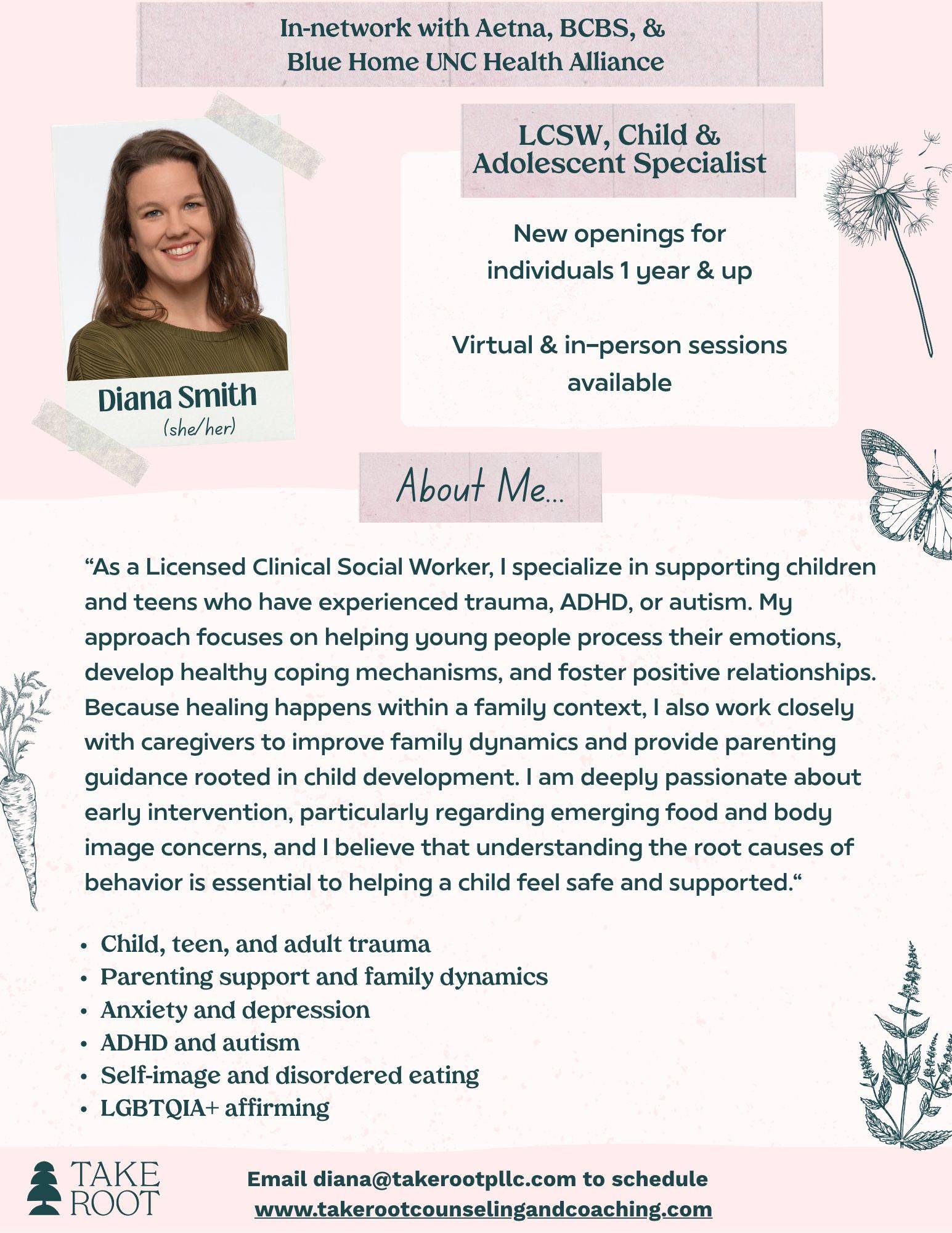
We are thrilled to welcome Diana Smith as our new Child and Adolescent Specialist. Diana is able to see clients as young as 1 year old and specializes in a variety of evidence-based modalities for kids, teens, and their families. She is kind, curious, and cares deeply about supporting healthy attachment systems while offering real skills and workable approaches to her clients.
Our Community Partners

Current Wellness: Pride Flow with Brit Guerin
Join Current Wellness for a yoga class to celebrate our pride! Pride Flow is an affinity space for the LGBTQIA+ community. This is to allow folks with similar lived experiences to practice in community. Brit (she/they) creates a space to allow participants to take up space authentically and fully.
All abilities are welcome and every pose is optional as we encourage folks to listen to and trust their own bodies. After class, we always have non-alcoholic drinks and snacks available for purchase at the wellness bar. And as a bonus, Pride Flow is great opportunity to meet new people in the broader Raleigh queer community!
Sunday, November 22nd at 11:00am
For the sustainability of our small business and to support our community sliding scale program that makes our offerings more accessible, there will now be a choice to attend Pride Flow for free or with two donation options ($15 – suggested price, $25 – supporter price).
Upcoming Support Groups
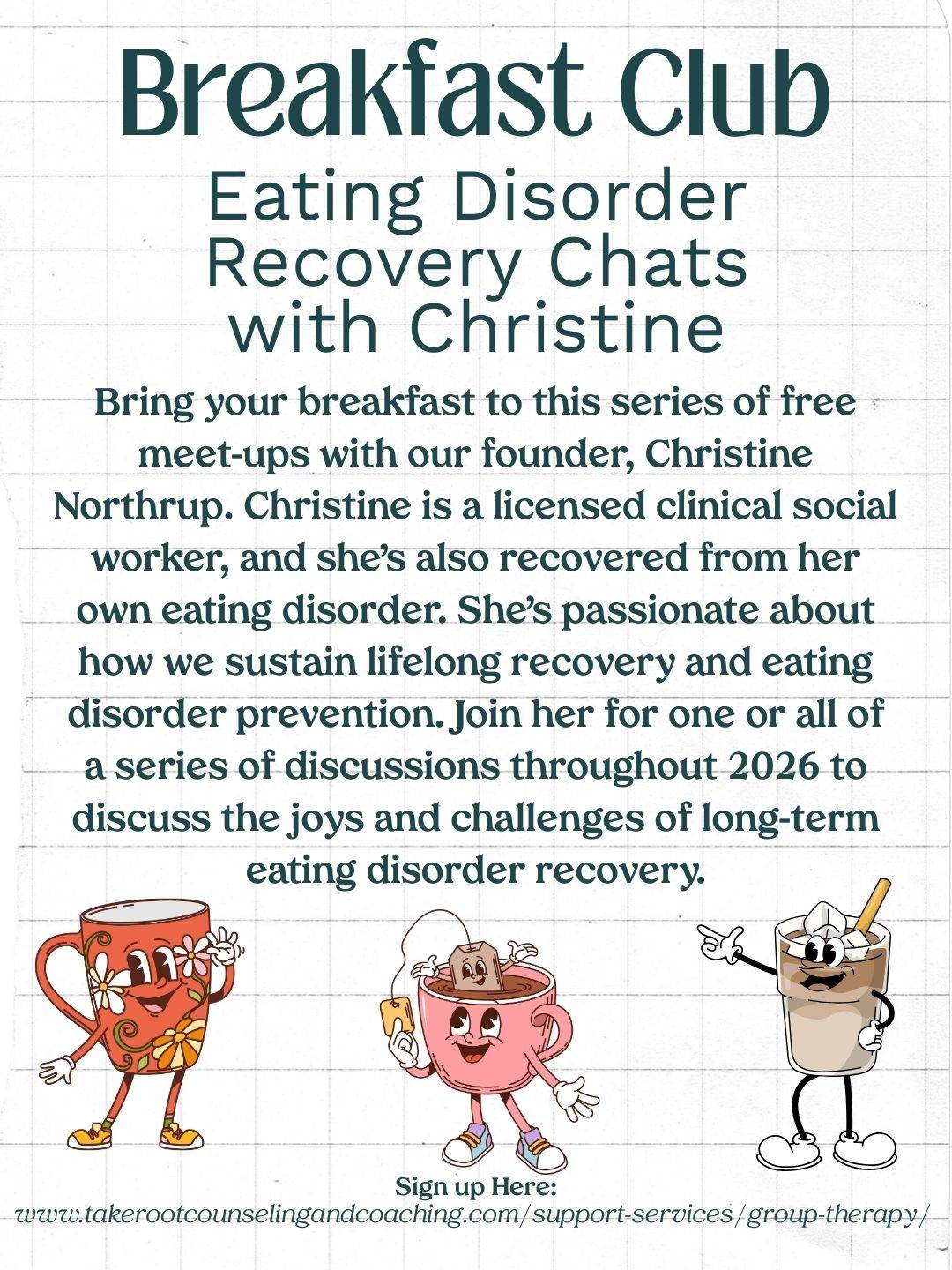
Dates: Meeting monthly on: 11/19, & 12/17
Time: Mornings, 8:30 – 10:00 am
Location: Our lovely office, 102 New Edition Court, Cary, NC
Cost: FREE
Who: This group is for folks 18+
Some things to know…
- All sessions are free of charge, but please make sure to register so we know to expect you
- This is not a meal support group, but it is a space designed to include eating so please bring your breakfast or your morning snack (for you early risers) and plan to meet your needs during the discussion.
- All those engaged in eating disorder recovery are invited to this discussion whether new to the process or long recovered. Whether the ask to eat during the chat is easy peasy or very scary, you get to be a part of the discussion.
If you made it this far, thanks for reading! We look forward to visiting your inbox again soon:) If the info in this email felt helpful, and you know someone who might also think so, please consider passing it along and sharing- we are so grateful for your support.
Kindly,
The Take Root Team

Receive this email from a friend or loved one? If you’d like to read The Sprout monthly, please consider signing up HERE.