September 10, 2026
September Greetings,
Fall is a few weeks away but the hustle and bustle that comes with this time of year has already met us with full force. During a recent team meeting we opened with the question, “What’s your favorite fall scent?” Fruit forward apple and camp fire were the two top favorites. We invite you into this convo, hit reply and let us know what your favorite autumn sniff!
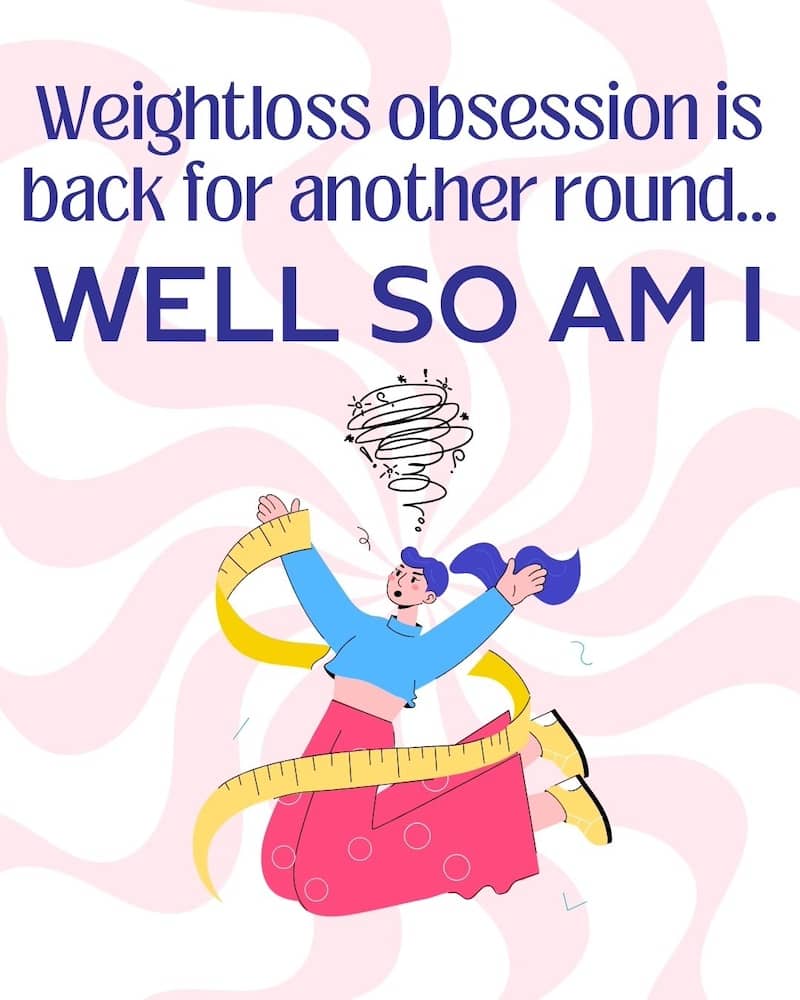
There’s a particular kind of exhaustion in realizing you’re fighting the same battle once again. It’s like you almost fully exhale, you nearly drop the hypervigilance, and then your opponent sneaks up in a new disguise. If your history includes standing in the magazine section of the Food Lion, devouring the images of emaciation in People magazine, hoping they would take the place of real nourishment and fill the hole in your belly where your Special K or SlimFast (or whatever) was absorbed hours ago, you may be experiencing a nauseating déjà vu.
A few months back, Take Root’s Social Work Intern, Amy Richards presented to our team on menopause and eating disorders, and menopause reframes which you can read more about HERE. As I absorbed the information she’d carefully crafted, I reflected on the similarities I’m seeing between puberty and perimenopause and the back drop of thin obsession that many of us are experiencing times two.
I came of age in the 1990s, when “heroin chic” made extreme thinness, pallor, and existing on air and cigarette smoke into a beauty standard. We navigated puberty and adolescence, trying to figure out who we were while the culture told us, explicitly, that disappearing was the goal. For me, and countless others, that culture contributed to a life-threatening eating disorder so perilous that I eventually devoted my career to trying to make things better for others. In the last decade, body positivity, the HAES® (Health at Every Size) movement, and fat activism movements made significant headway in having a more prominent voice. They created more space for body diversity and presented the question: What if we moved through our lives without devoting so much effort to fitting our bodies into boxes they were never meant to be in? Great freaking question! For a while, it seemed we were headed in a better direction. Not perfect, but there was reason to feel optimistic. Perhaps, the teens we served and our own children might have a fighting chance to exist in a culture that allowed their bodies to be, as is.
Unfortunately, a new but horrifically familiar challenge is upon us. Actually, it’s not new at all. It’s just packaged differently, which is how capitalism has harnessed the power of making people feel bad about themselves since the beginning of advertising. Though this blog is not a commentary on GLP-1’s, it is notable that the sharp increase in the availability, selling, and publicizing of such medications as a way to shrink one’s body has rolled out the red carpet for a weight-loss obsession to come back in very big and dangerous ways. And this is happening just as those of us who got our first periods with Calvin Klein’s Obsession ads playing in the background are now walking into the menopause transition.
I do not believe that this is a coincidence.
Why this moment is landing so hard
Eating disorders have long been stereotyped as a young person’s problem, but they don’t retire when adolescence ends. Research on women in midlife has found that eating disorder symptoms such as body dissatisfaction and disordered eating patterns are not only common but may be prevalent during perimenopause, likely tied to the hormonal volatility during that transition (Baker & Runfola, 2016). A more recent network analysis of women in perimenopause and early postmenopause echoed this, finding that some disordered eating symptoms show up at rates as high as 29% in this population (Finch et al., 2023).
In other words, there’s a real, biologically-informed vulnerability window here, and the culture has chosen this exact moment to center the act of shrinking. Those of us who experienced puberty and the brain development that occurs during that period may have a strong neurological association of social safety being tied to extreme thinness. So if you are toying with the idea of pursuing weight loss, in one way or another, and the thought of that brings you a wave of relief, you may actually be dealing with an old belief that got wired during your adolescent years that’s getting triggered by today’s resurgence of thin obsession. For anyone with a history of disordered eating, body image distress, or a nervous system already stretched thin by trauma or neurodivergence, a cultural moment that re-glamorizes emaciation isn’t just annoying. It’s a risk factor stacked on top of a risk factor.
The most insidious part about all of this is that advertising neuroscience knows that those of us who went through puberty during the 90’s may have a pretty deeply ingrained and conditioned relationship between our sense of worth and our ability to be thin. And now that we are going through peri-menopause (reverse puberty), they’re back to cash in once again. If that makes you angry, let it.
How I am navigating this
As a person who navigated recovery from an eating disorder and who now works in the field. I acknowledge that I am pretty bolstered against and protected from some of these influences. I am also aware that many people who are standing at the choice point of whether or not to go down the weight loss road once again are sometimes facing very real challenges. Including the fact that our world can make it very difficult to live in a larger body. It is very easy for me to see a multitude of reasons why someone would want to pursue weight loss, especially during this time. I don’t think we get anywhere by judging what other people are doing with their own bodies. You will notice that I have not used any particular celebrity’s name or given specific bodies as examples. That is because I’m not concerned with one person’s body, I am concerned with the centering of shrinking bodies as a whole, and the impact it will have on my clients, my children, the people I love, and the greater world. I am concerned about the collective energy that is wasted everyday on the pursuit of weight loss.
What many of us experience due to exposure to diet culture messaging is a mental hijacking that can steal years of energy, creativity and identity development. Rewiring your brain and responding differently to a thin-obsessed society is an ongoing process that takes bravery and intentionality. We all deserve to show up for ourselves that way. I’m going to wrap up with my top 5 ways to navigate this time.
- Just know that you don’t have to participate. When we have years of dieting in our histories, and our brains are set up to believe that pursuing weight loss is what we have to do for acceptance, love, or even just access to attractiveness. It is easy to jump into a weight loss pursuit before we’ve even thought it through. Step back and own your autonomy. Is this what you really want? Is it worth the trade-off? You can participate, but YOU DO NOT HAVE TO.
- Own your role. Thinking of the young people in my life who are coming of age today helps me to stand my ground. It ties me to my values and immediately ignites a love and belief in their birthright to embody their bodies, just as they are. They need people in their lives who have befriended their own bodies and who aren’t investing energy in the pursuit of weight loss.
- Pleasure! For many of us, our bodies can feel like sources of stress, pain, anxiety, or just like some big project… and they may be all of those things but they are also our way to experience pleasure. Try making pleasure as big a part of your life as any other sort of body project that you have going on. Or you may even need to start with very simple things that create pleasure (walking on a super soft carpet, noticing the smell of citrus, belting your favorite song, and noticing how good it feels in your body, maybe some dancing or stretching too).
- Find someone who gets you. You may have had some challenging feelings in friendships around weight loss being more popular again. I know I have experienced the thought, “But I thought we were on the same team!” Don’t give up on those friendships but consider adding some or growing some connection with people who more invested in body acceptance.
- Resource collecting: If you’re on social media, find resources that support you in accepting and befriending your body in its current shape and size. Find podcasts, books, and resources that promote and support weight neutrality and body wisdom. One I have really relished in the last year is “Unapologetic Aging” by our friend Deb Benfield (link to Deb)
References
Baker, J. H., & Runfola, C. D. (2016). Eating disorders in midlife women: A perimenopausal eating disorder? Maturitas, 85, 112–116. https://doi.org/10.1016/j.maturitas.2015.12.017
Benfield, D. (2025). Unapologetic aging: How to mend and nourish your relationship with your body. Sheldon Press.
Finch, J. E., Xu, Z., Girdler, S., & Baker, J. H. (2023). Network analysis of eating disorder symptoms in women in perimenopause and early postmenopause. Menopause, 30(3), 275–282. https://doi.org/10.1097/GME.0000000000002141

Our Community Partners
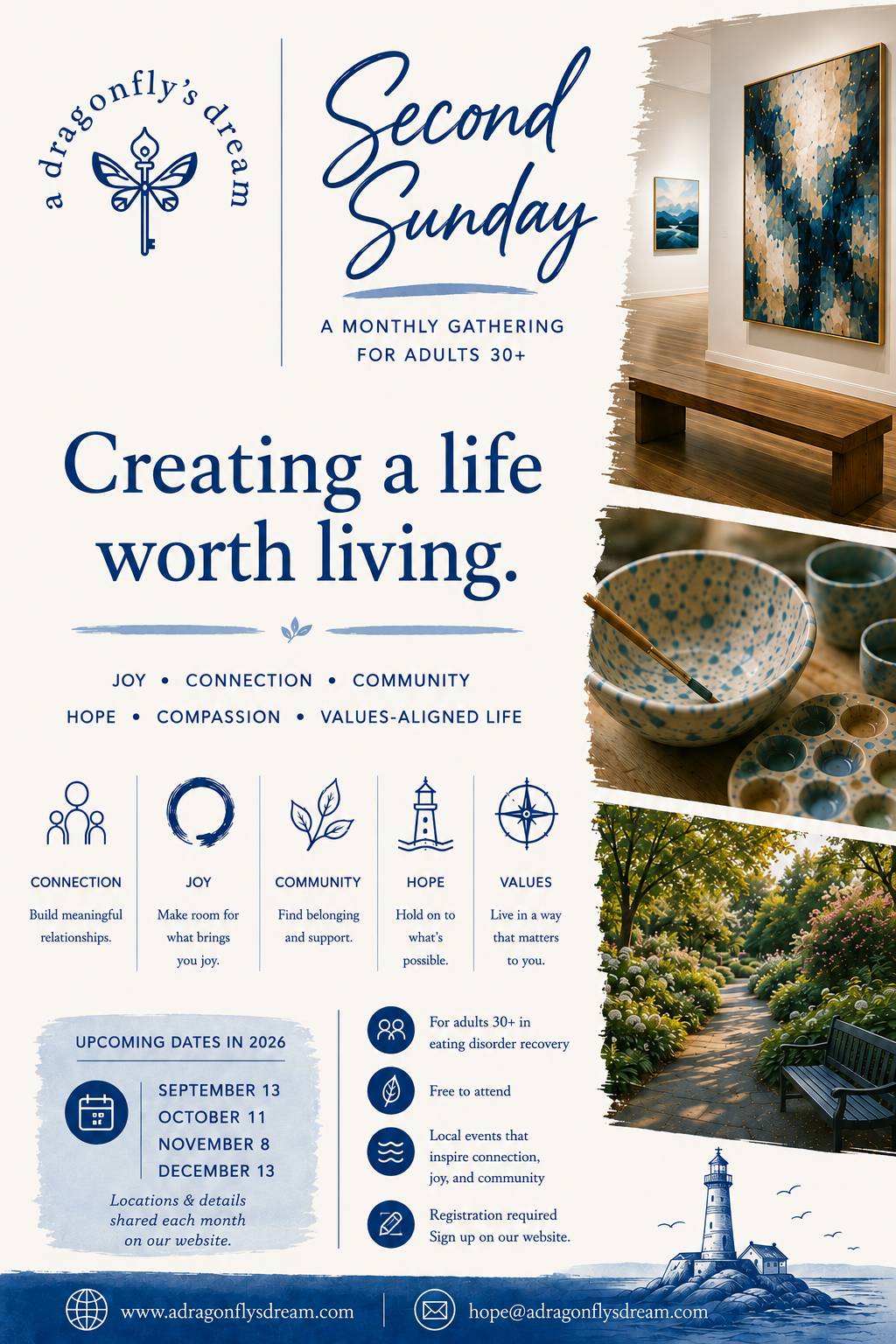
Our community partners at Dragonfly’s Dream have a brand new and creative offer to folks in eating disorder recovery. Learn more and register at the link below.
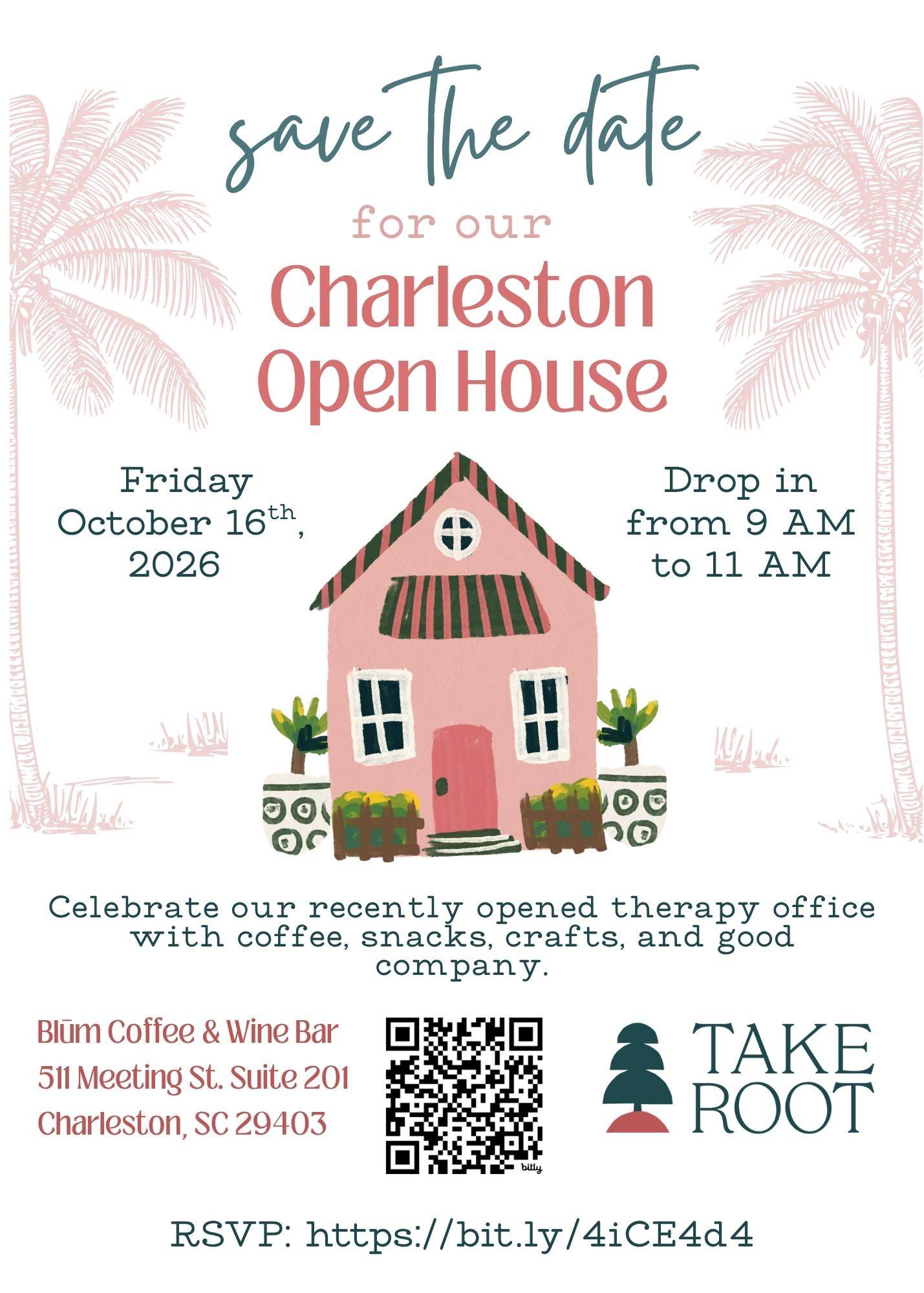
Join us to celebrate the opening of our Charleston office! Come meet our Charleston, SC team and enjoy some crafts, snacks and coffee at Blum Coffee & Wine Bar!
Upcoming Support Groups
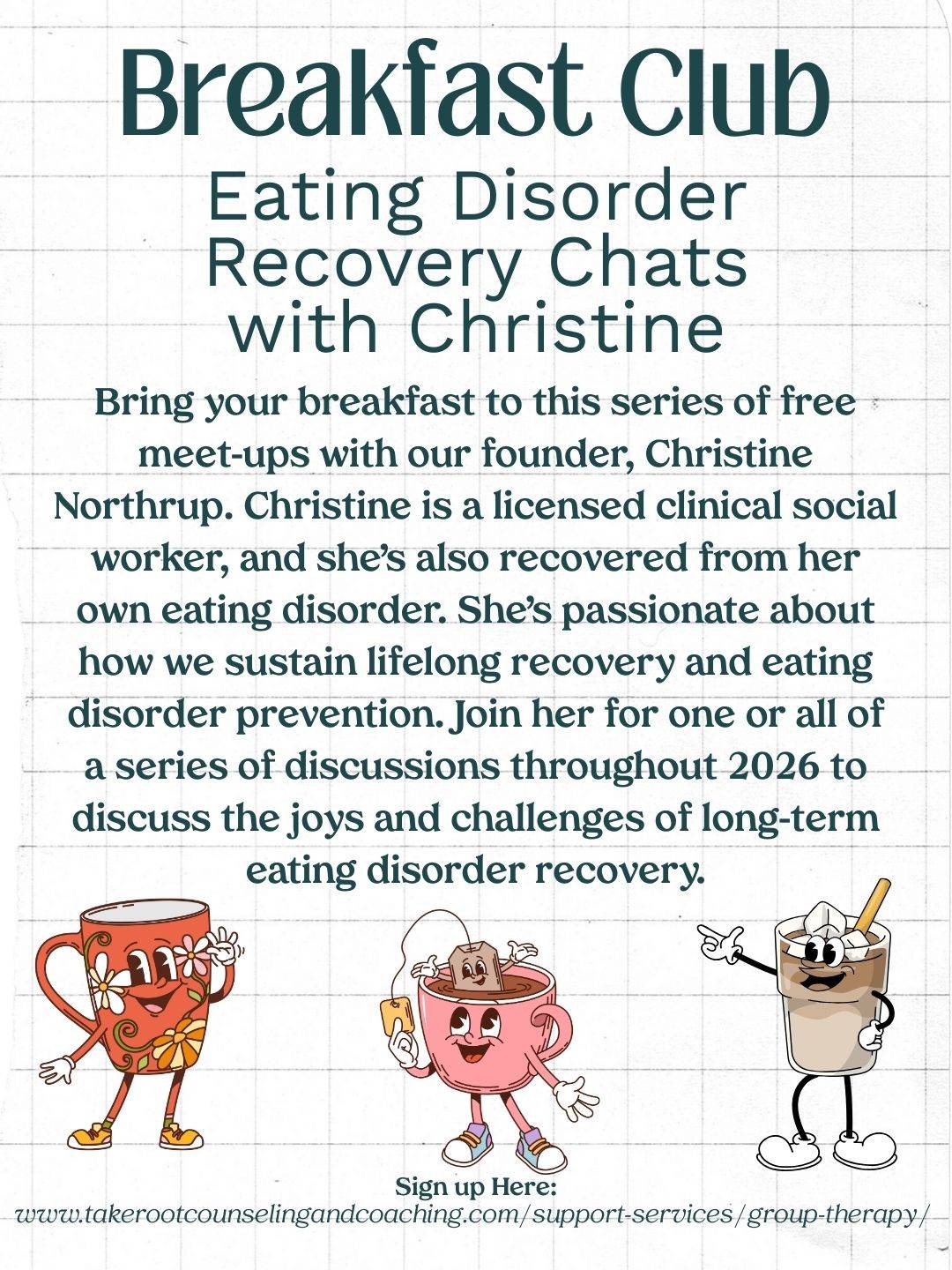
Dates: Meeting monthly on: 9/17, 10/15, 11/19, & 12/17
Time: Mornings, 8:30 – 10:00 am
Location: Our lovely office, 102 New Edition Court, Cary, NC
Cost: FREE
Who: This group is for folks 18+
Some things to know…
- All sessions are free of charge, but please make sure to register so we know to expect you
- This is not a meal support group, but it is a space designed to include eating so please bring your breakfast or your morning snack (for you early risers) and plan to meet your needs during the discussion.
- All those engaged in eating disorder recovery are invited to this discussion whether new to the process or long recovered. Whether the ask to eat during the chat is easy peasy or very scary, you get to be a part of the discussion.
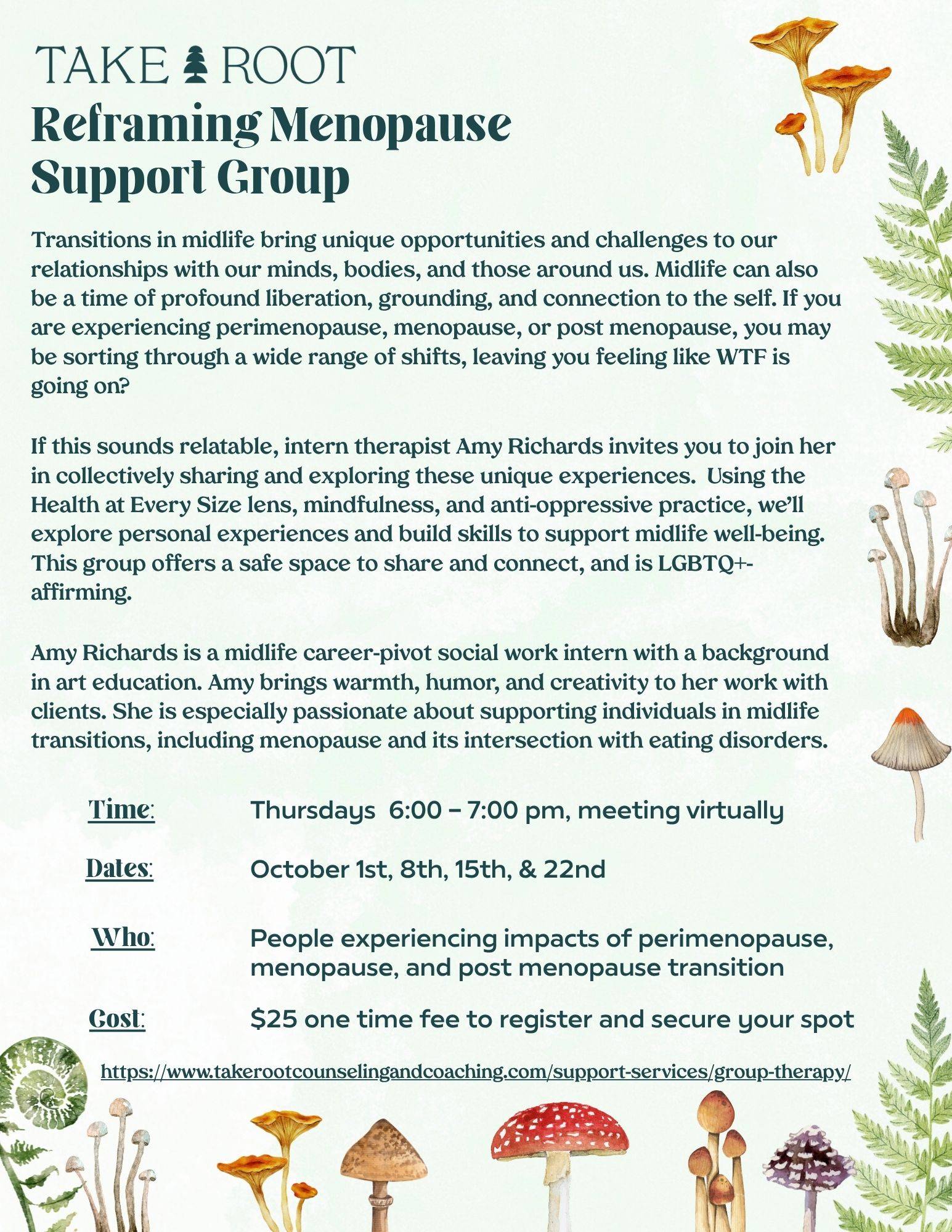
Our social work intern Amy Richards is really excited to offer this new group starting October 1. Please share this group with anyone you might think benefit from collective menopause support and exploring some ways to reframe this unique time of life.
Register for Reframing Menopause
If you made it this far, thanks for reading! We look forward to visiting your inbox again soon:) If the info in this email felt helpful, and you know someone who might also think so, please consider passing it along and sharing- we are so grateful for your support.
Kindly,
The Take Root Team
Receive this email from a friend or loved one? If you’d like to read The Sprout monthly, please consider signing up HERE.